


How AI Agents Will Reshape Work, Companies and Careers in Singapore and the World
6 October 2026, 10.00am - 11.00am
ZOOM
🤖 AI Agents and the Future of Work
As AI moves from responding to prompts to taking action, what does this mean for how we work?
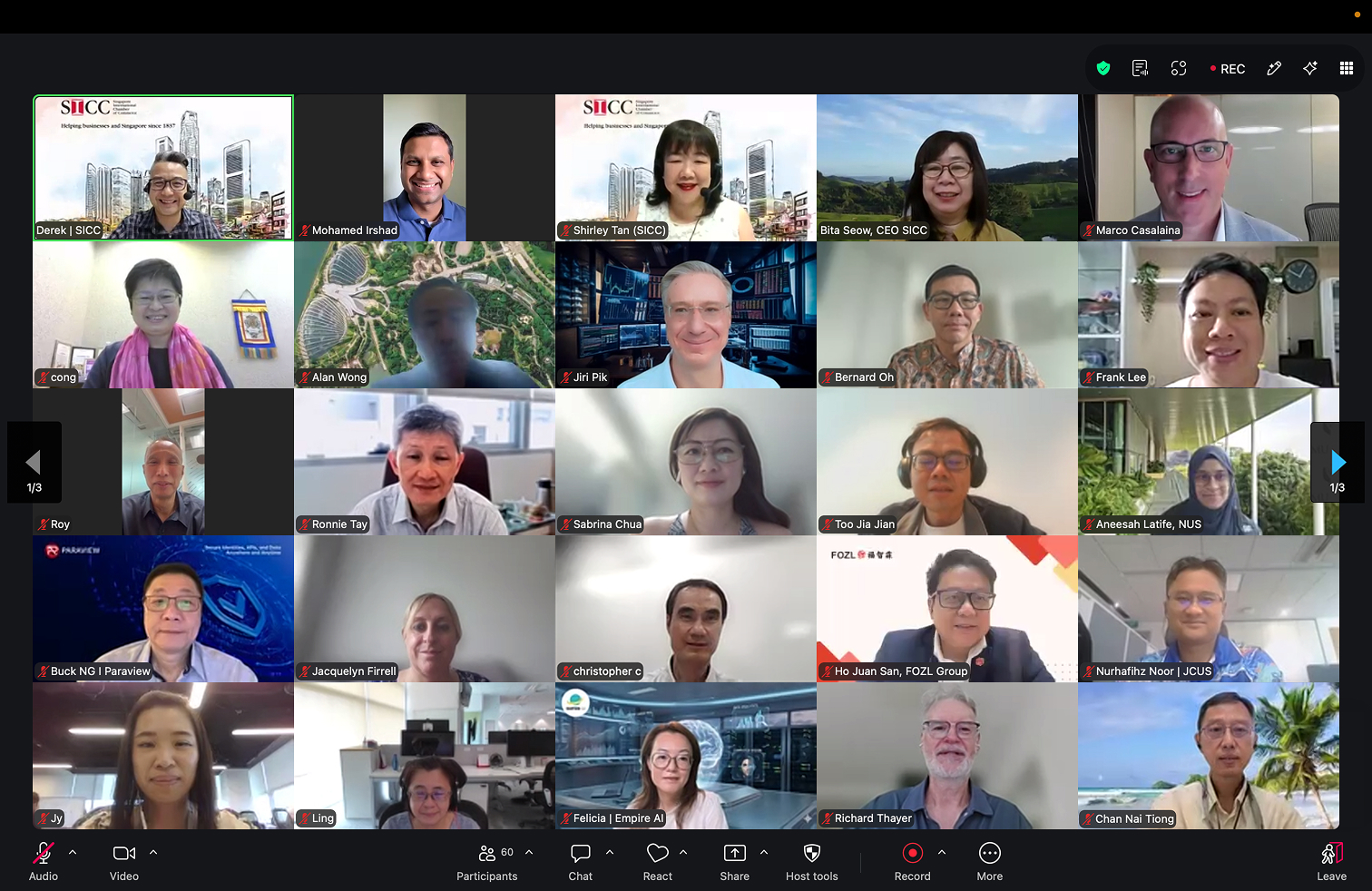
That was the focus of SICC’s Tech Transformation Resource Group webinar, where nearly 70 business leaders, professionals, academics and public sector representatives joined Mr Marco Casalaina, Vice President, Products, Core AI and AI Futurist at Microsoft, to explore how AI agents could reshape work, organisations and careers.
Through a series of live demonstrations, Marco showed how AI agents are evolving from tools that respond to prompts into systems capable of carrying out tasks, interacting with other systems and, increasingly, operating with their own identities and permissions.
Among the key insights shared:
💼 Skills will continue to evolve: As people work alongside AI, skills such as critical thinking, judgment, creativity, communication and domain expertise are likely to become increasingly important.
🛡️ AI adoption needs governance, not just experimentation: Moving beyond experimentation means considering how AI can deliver measurable value, while also putting in place appropriate security, permissions and oversight. Clear criteria, or “rubrics”, can help organisations assess whether AI agents have completed tasks securely, correctly and in line with organisational requirements.
🌐 Businesses may need to design for both people and AI agents: As agents increasingly act on behalf of users, organisations may need to consider how their websites, systems and customer journeys can be designed for both people and AI agents. Leadership, AI literacy and a culture of continuous learning will also be important as organisations navigate these changes.
The discussion reinforced a broader consideration for organisations: as AI capabilities evolve, businesses will need to consider not only what technology can do, but how people, processes and systems can work effectively alongside it.
Our sincere thanks to Marco for shaing his perspectives and bringing the subject to life through the live demonstrations, and to Mr Jiri Pik, Co-Chair of SICC’s Tech Transformation Resource Group, for his initiative and partnership in bringing this conversation to the SICC community.